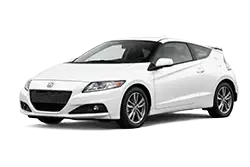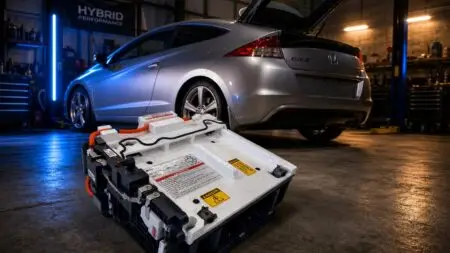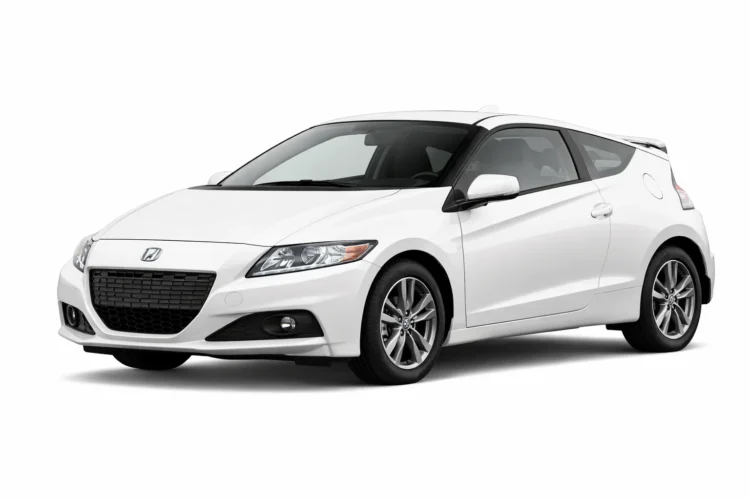
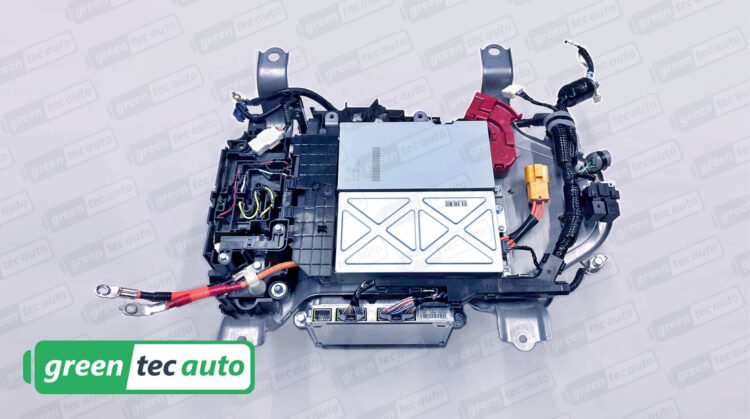
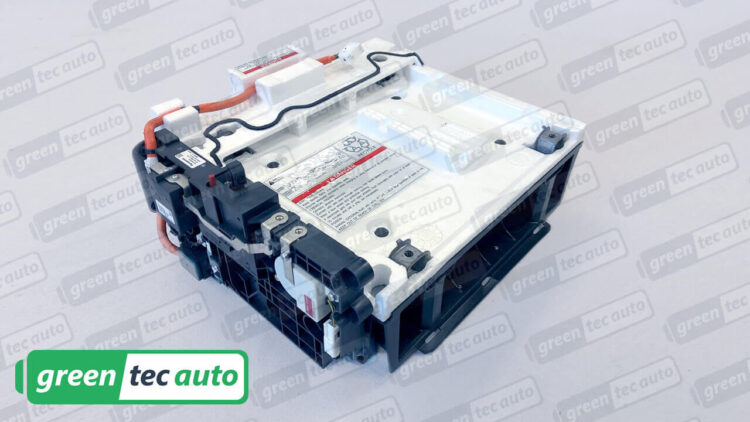
If your CR-Z feels heavy, Sport Mode has lost its punch, and the IMA light is on, the Integrated Motor Assist battery is a reasonable suspect. Before you price a replacement, though, there’s one thing to establish: the CR-Z used two completely different batteries, and they aren’t interchangeable. Cars from roughly 2010 to 2012 use a nickel-metal-hydride (NiMH) pack, while the 2013 facelift onward switched to a 144-volt lithium-ion pack.
Knowing which one you have determines your options, your diagnostics, and your price. This guide covers the failure symptoms, how the two generations differ, remanufactured versus new cells, and what professional installation involves.
The CR-Z relies on its Integrated Motor Assist system to deliver the torque that gives the car its character. The electric motor works alongside the gasoline engine, providing a burst of power during acceleration. When the high-voltage battery weakens, that partnership breaks down — the car feels uncharacteristically heavy, and Sport Mode loses the punch it used to have.
That sluggishness isn’t just a loss of fun. It’s a sign the vehicle’s computer is managing a power source it can no longer rely on. Left long enough, you can lose electric assist and regenerative braking entirely, leaving a small gasoline engine to carry a car that was designed around having help.
The most telling indicator is a jumpy state-of-charge gauge. If the bars drop from full to empty after a short drive, or shoot back to full unexpectedly, the modules are likely out of balance. You may also notice the IMA light staying on after a cold start, or a complete absence of green charging bars when coasting. All of these point to internal resistance rising to the point where the pack can’t operate reliably.
Hybrid batteries rarely fail overnight. A pack is a series of smaller cells grouped into modules, and they all need to stay balanced to work properly so what you usually experience is a gradual fade rather than a sudden death.
On a Honda CR-Z, the primary hybrid warning is the IMA light, often accompanied by a check engine light. Toyota owners frequently talk about a “Red Triangle of Death,” but that’s Toyota-specific terminology and indicator it isn’t what your Honda displays.
For the NiMH cars (roughly 2010–2012), the relevant codes include P1447 and P1449, which relate to IMA battery module deterioration and overheating, along with P0A7F (hybrid battery pack deterioration) and the generic P0A80 (“replace hybrid battery pack”). These are IMA-specific codes tied to the nickel-metal-hydride system; the 2013-and-later lithium-ion cars use a different diagnostic set.
Low-voltage faults can also mimic battery failure. A weak 12-volt battery sometimes triggers codes and symptoms that look like a hybrid problem but cost a fraction to resolve, which is exactly why a proper diagnostic should come before any purchase. A stored code tells a technician where the system sees trouble — it doesn’t confirm the entire pack has failed.
This is the first question to answer, because it changes everything downstream.
NiMH (roughly 2010–2012). The same proven, durable chemistry Honda used across its early IMA hybrids. These packs are mature and stable, though heavier and less energy-dense than what replaced them.
Lithium-ion, 144V (2013 facelift onward). Honda switched the CR-Z to lithium-ion alongside other hybrid system changes, delivering improved power delivery and slightly better efficiency.
Both are reliable chemistries with their own characteristics, and both respond well to professional remanufacturing. The important thing is simply knowing which one your car has, because it affects how the pack is rebuilt and what your replacement options look like. If you’re not sure, your model year and a quick diagnostic will confirm it immediately.
Once you’ve confirmed the battery is genuinely the problem, the choice comes down to how much longer you plan to keep the car and what your budget allows.
Remanufacturing goes well beyond swapping a failed module. Original cores are put through conditioning and load testing, with every module analyzed for capacity and internal resistance. Only modules meeting defined performance standards are selected and balanced into a cohesive pack.
This is the practical choice for a higher-mileage CR-Z where you want reliability without a major outlay, and it’s the lower-material-footprint option since it keeps existing components in service.
New cells haven’t been through years of heat and discharge cycles, which means lower internal resistance and more consistent IMA assist torque the thing that gives the CR-Z its character in the first place. If you plan to keep the car another five years or more, new cells offer the longest expected service life and the longest warranty coverage.
New cells are the higher-longevity option, not an equivalent to remanufactured. Either choice restores the electric assist and efficiency your CR-Z lost specifically to a worn pack; real-world fuel economy also depends on the engine, tires, weather, and driving habits.
Warranty coverage runs from 12 to 48 months depending on the battery you select, with unlimited-mileage options available on most qualifying batteries.
A dealership quote for a CR-Z hybrid battery can represent a significant share of the car’s value, which is what pushes some owners toward giving up on an otherwise sound vehicle.
Dealerships typically offer one solution — a new OEM pack at full retail, installed at book-time labor rates — and they don’t always stock hybrid packs, which can mean waiting while the part is ordered. Greentec Auto’s pricing runs 30 to 50 percent below typical dealership quotes, with shipping included on most orders across the continental United States.
A free diagnostic is part of that: because the only accurate figure is a quote for your specific car, confirming the actual condition of your pack costs you nothing before you decide anything.
High-voltage work isn’t a DIY project. The CR-Z pack weighs roughly 70 pounds, the job requires de-energizing the high-voltage system properly, and insulated tools and protective equipment are mandatory. Beyond the shock risk, an improper installation can damage sensitive electronics or leave the IMA system uncalibrated.
You have two options. In-shop service is available across Greentec Auto’s locations in the United States, Canada, and the United Kingdom, where the car is diagnosed, the battery replaced, and the system fully tested. Alternatively, mobile installation brings a technician to your driveway or workplace, which removes the towing problem when the car is sluggish or won’t run. Because the technician performs the installation on site, there’s no core deposit to manage — the old pack is simply collected at the time of service.
Your old core doesn’t go to a landfill. Every pack received is evaluated at the module level: modules that still hold usable capacity find a second life through Greentec Energy in applications like stationary power storage, while modules at the end of their life are processed through Greentec Recycling and their materials returned to the supply chain.
What gets recovered depends on your car’s chemistry. The NiMH packs in earlier CR-Z models yield nickel and other metals, while the 2013-and-later lithium-ion packs contain materials like lithium and cobalt.
Replacing a CR-Z hybrid battery is about reclaiming the driving experience the car was built around, not just clearing a dashboard light. Start by confirming which battery your car uses, get the pack properly diagnosed, then match the option to your plans — remanufactured for value on a higher-mileage car, new cells for longevity if you’re keeping it.
Check your model year to see the battery options available for your CR-Z, or schedule a free diagnostic.
The IMA light indicates a fault in the Integrated Motor Assist system. It often means the computer has detected an issue with battery health, such as module deterioration or overheating, and codes like P1447 or P1449 frequently accompany it on the NiMH cars. The vehicle will usually still run, but electric assist and regenerative braking may be disabled.
It depends on the year. CR-Z models from roughly 2010 to 2012 use a nickel-metal-hydride pack, while cars from the 2013 facelift onward use a 144-volt lithium-ion pack. The two are not interchangeable. Your model year, or a quick diagnostic, confirms which one you have.
Greentec Auto pricing typically runs 30 to 50 percent below dealership quotes. The exact figure depends on your battery type, whether you choose remanufactured or new cells, and the warranty term. Because those variables matter, the only accurate number is a quote for your specific car — and the diagnostic that produces it is free.
You can, but performance will be noticeably compromised. Without functional electric assist, acceleration becomes slow, auto stop-start may no longer work, and fuel economy drops. It’s generally safe to drive to a shop, but it isn’t a condition to leave unaddressed for long.
Remanufacturing describes a more rigorous standard than a basic module swap. Cells are individually tested, reconditioned, and balanced so the whole pack performs uniformly, rather than dropping one new module into an otherwise aged assembly — which tends to fail again before long.
Yes. A technician can come to your driveway or workplace with the battery and tools to perform the swap on site, which avoids the cost of towing a sluggish or non-running car. In-shop installation is also available across the location network.
Shipping is included on most orders across the continental United States. Some residential delivery types may incur an additional fee, and a refundable core deposit applies to shipped orders though not when a technician installs the battery for you.
*Offer cannot be combined with other promotions.
We use cookies and similar technologies to operate the website, understand how it is used, and support advertising. Optional analytics and marketing technologies will not be activated unless you give your consent. You can accept all, reject non-essential technologies, or manage your preferences. You can change your choices at any time.
Global Privacy Control has been detected. Advertising sale/share choices are disabled where configured.