This is the detail that makes almost all winter hybrid advice confusing, because most of it was written for electric cars.
An EV owner watching cold weather sees a smaller number on the range display. A hybrid owner sees something different: the gas engine running when it used to be quiet, the EV indicator barely lighting up, and fuel economy dropping 10 to 25 percent. Nothing is wrong with your range, because your range comes from the fuel tank. What changed is the balance between electric and gasoline operation, and in winter that balance shifts hard toward gasoline.
That shift is not a malfunction. It is three things happening at once, all of them by design:
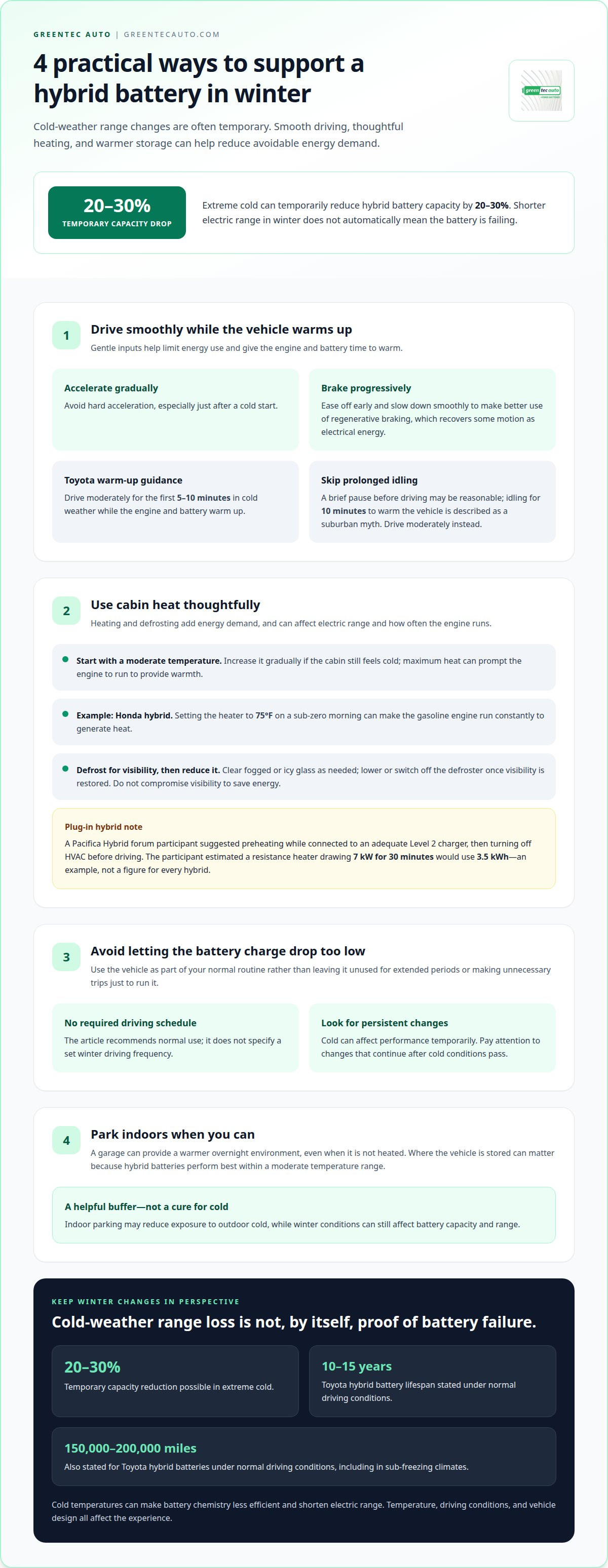
Extreme cold can temporarily reduce a hybrid battery’s usable capacity by roughly 20% to 30%. None of that is permanent, and none of it means the pack is failing. It comes back when the weather does.
So the useful question for a hybrid owner in January is not “how do I get my range back.” It is: what is normal, what actually helps, and how do I tell the difference between winter and a dying battery? Here is all three.
Worth understanding before anything else, because it explains why generic winter EV advice does not fit your car and why some of it would actively mislead you.
A hybrid has an advantage an EV does not: the engine makes heat for free. An EV has to generate cabin heat from the battery, which is why electric cars lose such a large share of range in winter. Your hybrid’s engine produces waste heat as a byproduct of running, and the climate system uses it. You are not spending battery capacity to stay warm in the way an EV owner is.
The tradeoff is that the engine has to run to make that heat. On a cold morning with the heat on, the engine may run almost continuously for the first several miles even at low speeds where it would normally shut off. That is the cost, and it shows up as fuel economy rather than range.
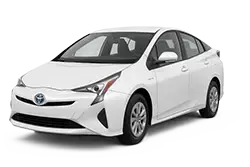
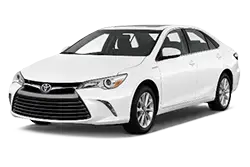
Conventional hybrids do not plug in. This matters because a lot of cold-weather advice centers on preconditioning while connected to a charger. If you drive a Prius, Camry Hybrid, Accord Hybrid, RAV4 Hybrid, or any other conventional hybrid, there is nothing to plug in. Your battery is charged by the engine and by regenerative braking, full stop. Plug-in hybrids are the exception and should follow their own charging guidance.
Battery chemistry varies across hybrids. Older Toyota and Honda hybrids use nickel-metal hydride packs, while many newer hybrids use lithium-ion. Both lose available power when cold, and the core winter habits are the same for both. Follow your own vehicle’s guidance for anything model-specific.
The practical consequence: in winter, watch your fuel economy, not a range number. And expect it to drop. Every hybrid does.
Gentle driving matters more in winter than in summer, and for a reason most articles skip.
When a hybrid battery is cold, the battery management system limits how much charge it will accept. Pushing energy into a cold battery too quickly is genuinely harmful, so the system does not allow it. The practical result is that regenerative braking is reduced until the pack warms up. You may notice the brake pedal feeling slightly different, or the energy monitor showing less charge recovery than you are used to on the same off-ramp.
That is the car protecting the battery. It also means the friction brakes are doing more of the work in the first few miles of a cold trip, which is worth knowing both for how you drive and for why hybrid brake pads sometimes wear differently in cold climates.
Drive moderately for the first 5 to 10 minutes rather than idling in the driveway. Toyota’s guidance for hybrid owners is moderate driving during warm-up, avoiding hard acceleration. Honda’s is similar, with a brief 30 to 60 second pause before setting off being sufficient.
A long stationary warm-up accomplishes almost nothing. An idling engine warms up slowly because it is barely working, it burns fuel while covering no distance, and it recovers no energy through regenerative braking. Driving gently warms the engine, the transmission, the cabin, and the battery faster than idling does. If you want the cabin warm before you leave, a minute or two is plenty, and then drive.
Do not rev the engine to speed up warm-up. It does not work and it loads cold oil.
Use it as part of your normal routine. There is no required schedule, and making unnecessary trips just to run the car accomplishes nothing useful. What you want to avoid is the opposite extreme: leaving a hybrid parked and unused for many weeks in deep cold with a low state of charge.
<h2id=”3″>3. Cabin heating and defrosting: the biggest controllable cost
Of everything in this guide, this is the one with the largest effect on your winter fuel economy, and the one most owners have never thought about.
Setting the climate control to maximum heat on a cold start tells the vehicle to run the engine until it can deliver that heat. The engine is the heat source. Demand a lot of heat and the engine runs a lot, including at speeds and conditions where it would otherwise shut off and let the electric side work.
The practical difference is real. A hybrid asked for a moderate cabin temperature will cycle its engine normally once warm. The same hybrid with the temperature pinned at the top of the dial can keep the engine running continuously on a cold morning, which is exactly the behavior owners then worry about.
This matters more than any fuel saving in this article. A fogged or iced windshield is a safety problem. Run the defroster as long as you need it. The goal is to turn it down once the glass is clear, not to drive squinting through a porthole to save a tenth of a mile per gallon.
Plug-in hybrids have an option conventional hybrids do not: preheat the cabin while still connected to the charger, so the warm-up runs on grid power instead of your pack. Set it to finish just before you leave. This is one of the most effective winter habits available to a PHEV owner, and it does not apply to conventional hybrids at all.
<h2id=”4″>4. Cold weather effects on hybrid battery capacity and range
A cold snap changes how a hybrid battery performs without proving anything has failed. Extreme cold can temporarily reduce usable capacity by roughly 20% to 30%, and the reasons are physical rather than a sign of damage.
Cold raises the battery’s internal resistance. Higher resistance means less power available on demand, less power accepted during charging, and more energy lost as heat during both. The pack has not lost capacity in any permanent sense. It simply cannot access as much of it until it warms up.
What you will actually notice in a hybrid:
What is also happening that has nothing to do with the battery:
Winter hurts fuel economy in gasoline cars too, and hybrids inherit all of it. Cold air is denser, which increases aerodynamic drag. Tire pressure drops roughly one PSI for every 10 degrees Fahrenheit, which raises rolling resistance. Winter fuel blends carry slightly less energy. Cold engine oil is thicker. Snow and slush add drag. Short trips never let anything reach operating temperature.
Add all of that to the battery effect and a 20% winter MPG drop stops looking mysterious.
One thing worth checking in winter: a weak 12-volt auxiliary battery can produce symptoms that imitate hybrid system faults, and cold weather is exactly when marginal 12-volt batteries fail. It is one of the first things a competent diagnostic rules out before anyone discusses the traction pack, and it is a far cheaper answer.
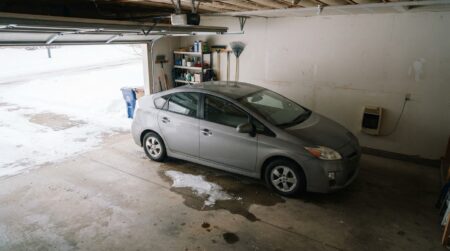
Parking indoors is the easiest win in this entire guide because it requires no behavior change at all, just a choice of where to leave the car.
An unheated garage is often 10 to 15 degrees Fahrenheit warmer than a driveway overnight. A 9°F driveway can correspond to a roughly 24°F garage. The exact difference depends on the building, but the principle holds: any enclosure buffers the car from outdoor air, wind, and radiant heat loss to the night sky.
That matters because the battery starts your next trip at the temperature it was stored at. A pack that spent the night at 24°F warms up faster and performs better in the first few miles than one that spent the night at 9°F.
A heated garage helps more, and is not necessary. The goal is reducing exposure, not holding the battery at a target temperature. Use the garage over the driveway, especially during severe cold. If you only have outdoor parking, that is fine, and the other habits in this guide matter more for you.
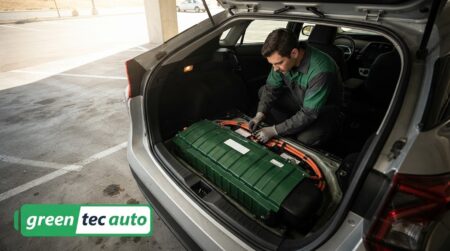
Most hybrid packs are air cooled through an intake, often located low near the rear seat or in the trunk area. Keep it clear. Do not stack luggage, groceries, pet carriers, or winter gear over it, and do not let snow tracked in from boots pile against it. Blocked airflow is a problem in any season.
If the car will sit for weeks:
Hybrid batteries operate best somewhere around 60°F to 85°F. That is a description of favorable conditions, not a target you are expected to maintain. Your battery will spend most of the winter outside that range, and that is normal and expected.
Two things worth separating:
Battery temperature is not outdoor temperature. The pack warms as the car operates, from its own internal resistance and from the cabin around it. A battery in a car that has been driving for thirty minutes is considerably warmer than the air outside. This is part of why the first few miles of a cold trip feel different from the rest of it.
Longer trips are gentler than short ones. A 25 minute drive lets the engine, cabin, and pack all reach reasonable temperatures and then operate efficiently. Four separate six minute errands never let anything warm up and are the worst case for winter fuel economy. If you can combine errands into one trip, that single change does more for your winter MPG than anything else on this list.
Treat 60°F to 85°F as a reference point for understanding what is happening, not a specification to chase. Nobody needs to heat a garage to 70 degrees.
It sounds backwards to talk about cooling in a winter article. It is not, and here is why it belongs here: winter is when the intake gets blocked, and summer is when you pay for it.
Hybrid packs generate heat whenever they work, in any weather, and most of them are cooled by drawing cabin air through an intake, past the modules, and out. The intake usually has a filter or screen, and there is a fan behind it.
Over time that path fills with dust, pet hair, and debris. In winter it also collects road salt residue and whatever comes off boots in the back seat. A restricted intake means the pack runs hotter than designed, and heat is the main thing that permanently ages a hybrid battery. The damage is not done in January. It is done the following July, by a pack that can no longer cool itself properly.
What to do:
This is the least glamorous item in this guide and probably the highest value per dollar.
Everything above describes normal cold-weather behavior. Here is how to tell when it is not.
The test is persistence. Weather effects are seasonal and they reverse. Battery degradation is permanent and it progresses.
Signs it is just winter:
Signs it may be the battery:
This costs nothing and makes any future conversation with a shop dramatically more useful. When something changes, note the outside temperature, the route, how you had the climate control set, the trip length, your fuel economy, and the mileage. Two data points from the same route in the same season a year apart tell you more than any single reading.
A short winter commute with heavy cabin heat is not comparable to a long drive in mild weather, even in the same car. Compare like with like, and look for the pattern rather than reacting to one bad morning.
There is no single price for hybrid battery replacement because it depends on the vehicle, the battery, and the installation. Warranty coverage depends entirely on your vehicle’s specific terms, and cold weather by itself does not establish whether a given condition is covered. If you are near the end of a warranty period and suspect genuine capacity loss, get it measured before the window closes rather than after.
A diagnostic measures the battery. A range or MPG estimate measures the weather, your driving, and your route, all mixed together. That is the difference, and it is why guessing is expensive.
The honest version: your hybrid is handling winter far better than it feels like it is, and most of what you are noticing is the system working as designed.
The four things that genuinely help are not complicated.
None of it will stop winter from costing you fuel economy. All of it reduces the avoidable part, and the first and third items pay off year round.
What matters most is the thing you do in April: check whether the same route and the same driving brought your fuel economy back. If it did, winter was the whole story. If it did not, that is the signal worth acting on.
Greentec Auto replaces hybrid and EV batteries at more than 30 locations across the U.S., Canada, and the U.K., and has been doing this work since 2012.
Winter performance changes are usually temporary, which is exactly why the first step is testing rather than replacing. Free battery testing and diagnostics tell you whether you are looking at a seasonal effect, a weak auxiliary battery, a cooling fan or sensor fault, or genuine capacity loss in the traction pack. Replacing a pack that was not the problem does not fix the car.
If testing does show real capacity loss, replacement options include new-cell packs built with new cells rather than reclaimed modules, which deliver longer service life than remanufactured options, alongside remanufactured packs where those suit the vehicle. Warranty coverage applies to most qualifying batteries, and because the network spans more than 30 locations, a claim is not tied to a single address.
Greentec Auto supplies replacement batteries across Toyota, Lexus, Honda, Ford, and other hybrid and EV platforms. Mobile installation is available on many vehicles for an additional cost, and some models require shop installation. Modules that fail testing go to Greentec Recycling, where nickel and other metals are recovered from nickel-metal hydride packs and lithium and cobalt are recovered from lithium-ion packs.
Check your year, make, and model on greentecauto.com, or contact Greentec Auto to have your battery tested before winter decides it for you.
Yes, temporarily. Cold raises the battery’s internal resistance, which reduces how much power it can deliver and how much charge it will accept, cutting usable capacity by roughly 20% to 30% in extreme cold. In a hybrid this shows up as the gasoline engine running more and fuel economy dropping rather than as lost range, because the range comes from the fuel tank. The effect fully reverses when temperatures rise and is not evidence of a failing battery.
Yes, and commonly by 10% to 25% in genuinely cold conditions. Several things stack up: a cold battery delivers less electric assist, the engine runs to make cabin heat, the engine runs to warm itself, cold air is denser, tire pressure drops, winter fuel blends carry slightly less energy, and short trips never let anything reach operating temperature. Every hybrid does this. A drop that does not recover as the weather warms is the one worth investigating.
Drive moderately for the first 5 to 10 minutes rather than idling to warm up, set a moderate cabin temperature instead of maximum heat, park indoors when possible even in an unheated garage, keep the battery cooling intake clear of snow and belongings, and avoid leaving the pack at a very low state of charge through deep cold. Combining short errands into one longer trip helps more than most owners expect, because a warm system is an efficient one.
A brief pause is enough, roughly 30 to 60 seconds. Extended idling warms the engine slowly because it is barely working, burns fuel while covering no distance, and recovers no energy through regenerative braking. Driving gently warms the engine, cabin, and battery faster than idling does. Toyota’s guidance is moderate driving for the first 5 to 10 minutes without hard acceleration, and revving a stationary engine to speed up warm-up does not help.
Because the engine is the heat source. When you ask for substantial cabin heat, the vehicle runs the engine to produce it, including at low speeds where it would normally shut off and let the electric side work. A cold battery also delivers less assist, so the system leans on the engine more, and the engine runs to reach its own operating temperature. Setting a moderate cabin temperature instead of maximum heat is the most effective way to reduce this.
Because the battery management system limits how much charge a cold battery may accept. Pushing energy into a cold pack too quickly is genuinely harmful, so the system restricts it until the battery warms. The practical effect is less energy recovery and more work for the friction brakes in the first few miles of a cold trip. This is the vehicle protecting the battery, and it resolves on its own as the pack warms up.
Only if it is a plug-in hybrid. A conventional hybrid such as a standard Prius, Camry Hybrid, or Accord Hybrid has no external charging port, and its battery is charged by the engine and by regenerative braking. If you do drive a plug-in hybrid, preheating the cabin while still connected is one of the most effective winter habits available, because the warm-up runs on grid power instead of your pack.
Ordinary cold-weather operation does not. The capacity you lose in winter returns in spring. Heat is what permanently ages a hybrid battery, which is why keeping the cooling intake clear matters more for long-term battery life than anything related to cold. The one genuine cold-weather risk is leaving a pack sitting at a very low state of charge through sub-zero weather for an extended period, which is worth avoiding.
Persistence is the test. Weather effects are seasonal and they reverse; degradation is permanent and it progresses. If your fuel economy drops in December and recovers in April, that was winter. If it stays down through mild weather, or gets worse each year, that is the battery. Warning lights, a state-of-charge gauge swinging wildly, the engine running constantly in mild weather, or a loss of available power all point toward a diagnostic rather than another season of waiting.
Cost depends on the vehicle, the battery type, and the installation, so there is no single figure across all hybrids. Warranty coverage depends on your vehicle’s specific terms, and cold weather by itself does not establish whether a condition is covered. What determines a warranty claim is usually whether measured capacity has fallen below a stated threshold within the covered period. If you are near the end of a warranty window and suspect real capacity loss, get it measured before the window closes.
*Offer cannot be combined with other promotions.
We use cookies and similar technologies to operate the website, understand how it is used, and support advertising. Optional analytics and marketing technologies will not be activated unless you give your consent. You can accept all, reject non-essential technologies, or manage your preferences. You can change your choices at any time.
Your browser sends a Global Privacy Control signal, so advertising stays off unless you switch it on yourself.