Cold weather and extreme heat both cut your driving range, but they are not the same problem, and treating them the same is why so much EV advice is confusing.
Cold costs you range temporarily. Heat costs you capacity permanently.
A 25% range drop on a January morning is not damage. Your battery has not lost anything. The chemistry is slower when it is cold, and your car is spending energy warming the cabin and the pack instead of turning the wheels. When spring arrives, that range comes back. Every bit of it.
Heat works differently. Sustained high temperatures speed up the chemical reactions inside the cells that permanently reduce how much energy the pack can hold. That loss does not come back in October. It accumulates, summer after summer, and it is the reason an EV that spent five years in Phoenix usually has a weaker battery than the same model that spent five years in Seattle.
So if you are watching your range drop as the temperature falls this week, the honest answer is: relax. If you live somewhere with 110°F summers and your range has been quietly shrinking for years, that is the one worth paying attention to.
Everything below separates those two situations.
Table of Contents
Yes. Both reduce an electric vehicle’s driving range, but through completely different mechanisms and with completely different long-term consequences.
In cold weather, the electrochemical reactions inside the cells slow down, which temporarily reduces how much power the pack can deliver and accept. At the same time, the vehicle spends energy warming the cabin and often the battery itself. Neither of those effects damages anything. Both reverse when the weather does.
In hot weather, two separate things happen. The cooling system and the air conditioner draw energy, which cuts range in the short term. And sustained high cell temperatures speed up the internal chemical reactions that permanently reduce usable capacity. That second effect is the one that follows you around for the life of the car.
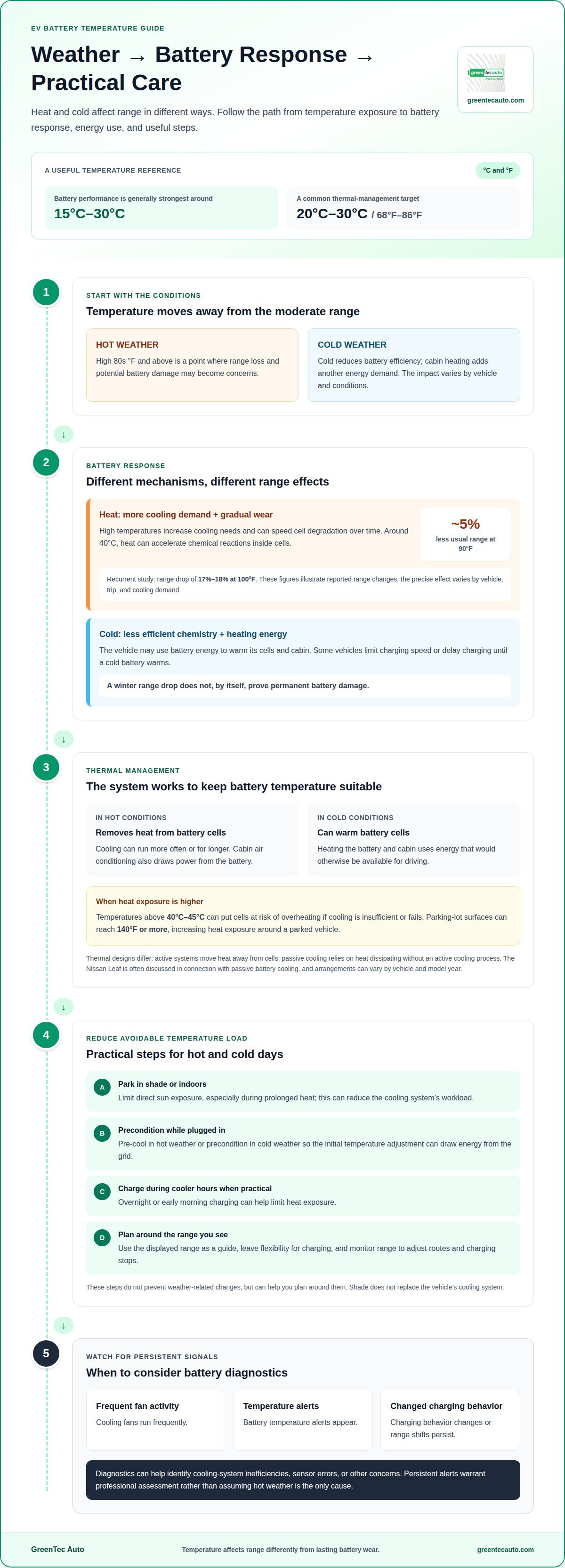
Most lithium-ion EV batteries operate best somewhere around 60°F to 85°F, or roughly 15°C to 30°C. Outside that window in either direction, you are asking the vehicle’s thermal management system to do more work, and that work costs energy.
There is no single temperature where “extreme” begins. As a practical reference point, range loss and long-term heat stress tend to become real concerns once ambient temperatures climb into the high 80s Fahrenheit and above, and cold-weather range loss becomes obvious once you drop below freezing. Those are starting points for attention, not cliffs.
Most electric vehicles lose roughly 20% to 30% of their rated range once temperatures fall below freezing, though real-world results vary widely by model. Analysis of large fleets of connected EVs has consistently found the average vehicle retaining somewhere in the neighborhood of 70% to 80% of its usual range in freezing conditions.
That spread is the important part. The difference between a car that loses 15% and one that loses 35% is not the battery chemistry alone. It comes down to:
Heat has a smaller effect on range than cold does, but it is not nothing. Studies of connected EV fleets have found range reductions in the range of roughly 5% around 90°F, climbing substantially as temperatures approach and pass 100°F, with some analyses of extreme heat finding losses approaching 30% in the worst conditions.
Here is how the two compare:
Cold weather | Extreme heat | |
|---|---|---|
Typical range impact | Roughly 20% to 30% below freezing | Smaller at moderate heat, growing above 100°F |
Is it permanent? | No. Range returns when temperatures rise | Partly. Capacity loss accumulates and does not recover |
Main cause | Slower chemistry plus cabin and battery heating | Cooling system and A/C draw, plus accelerated cell aging |
Charging effect | Slower charging until the pack warms | Charging may be throttled to protect a hot pack |
Best single habit | Precondition while plugged in | Park in shade or a garage |
Should you worry? | No. This is normal and seasonal | Yes, over years, especially in hot climates |
The practical takeaway for winter: plan your trips on the range your car is actually showing you, not the number on the window sticker. Leave more margin than you would in May, and expect charging to take longer when the pack is cold.
Most generic cold-weather EV advice ignores something that matters a great deal: not all EV batteries use the same chemistry, and the two common types behave differently when it gets cold.
Lithium iron phosphate packs, usually called LFP, are durable, tolerate frequent full charges well, and are generally less sensitive to heat-related degradation. They also tend to be noticeably more affected by cold, both in available power and in charging speed. Many manufacturers that use LFP recommend charging to 100% regularly, partly because the chemistry handles it and partly because it makes the state-of-charge reading more accurate.
Nickel-based packs, including the various NCM and NCA formulations, generally hold up better in cold conditions but are more sensitive to the heat stress described later in this guide. These are the packs where the common advice about staying in a middle state-of-charge range is most relevant.
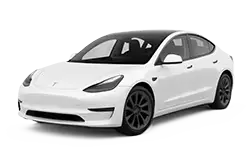
This is not academic. The same model from the same year can have different chemistry depending on trim. The Tesla Model 3 is the clearest example: rear-wheel-drive and standard versions have used LFP, while Long Range and Performance versions use nickel-based cells. Two Model 3s in the same parking lot on the same cold morning can behave differently, and both are working exactly as designed.
Before you take any charging or cold-weather advice as universal, find out which chemistry your car has. Your owner’s manual or the manufacturer’s charging recommendation screen will tell you. Advice built for one chemistry can be actively wrong for the other.
Preconditioning means warming the cabin and the battery while the vehicle is still plugged in, so that energy comes from the wall instead of from your pack. If you do only one thing differently this winter, do this.
The reason it works so well is that the largest single energy cost of cold-weather driving is the first few minutes. Warming a cold cabin from freezing takes real power. Warming a cold battery takes real power. If both happen while you are connected to a charger, neither one spends a single mile of your range.
How to use it well:
The same feature helps in summer. Pre-cooling a cabin that has been sitting in direct sun while the car is plugged in means the air conditioner does its hardest work on grid power, before you ever pull out.
An EV’s thermal management system exists to keep the pack inside a usable temperature band. Many systems target something close to 68°F to 86°F, or 20°C to 30°C. In hot weather, the system pulls heat out of the cells. In cold weather, many systems can warm them. How aggressively it does either depends on battery temperature, outside conditions, and how the vehicle was engineered.
That management is not free. Cooling runs on energy from the battery, and so does the cabin air conditioner. On a hot day, cooling the interior and managing pack heat can noticeably reduce how much energy is left for driving. A vehicle that has been baking in direct sun needs far more cabin cooling after startup than one that spent the afternoon in a garage.
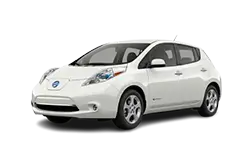
Thermal management designs differ, and the difference is significant. Active systems circulate liquid coolant or use refrigerant to move heat away from the cells, which gives the vehicle real control over pack temperature. Passive designs rely on heat dissipating to the surrounding air without an active loop, which means the pack’s temperature follows ambient conditions far more closely. The early Nissan Leaf is the most widely discussed example of passive battery cooling, and it is also frequently cited in discussions of accelerated degradation in hot climates. Cooling arrangements vary across manufacturers and model years, so the question worth asking about any used EV is how its pack is cooled, not just how many miles are on it.
Cells become genuinely at risk when temperatures climb past roughly 104°F to 113°F, or 40°C to 45°C, and cooling is insufficient or failing. Context matters here: asphalt in a hot parking lot can exceed 140°F, which raises the temperature of everything sitting on it. Shade does not replace the cooling system, but it reduces the amount of heat that system has to fight.
Practical ways to reduce unnecessary cooling demand:
If cooling fans run constantly, temperature warnings appear, or charging behavior changes in ways the weather does not explain, that is worth a diagnostic rather than a guess. Coolant leaks, failed pumps, and faulty temperature sensors all present as “the cooling system is working too hard,” and none of them fix themselves.
This is the part of the impact of extreme heat on EV battery life that actually matters, and it is also the part nobody notices until years have passed.
At sustained temperatures around 104°F, or 40°C, elevated heat accelerates the chemical reactions inside the cells that permanently reduce usable capacity. Unlike cold-weather range loss, this does not reverse. It compounds. A single hot afternoon is irrelevant. Five summers of a pack sitting at high temperature in an uncovered lot is not.
Three things drive cumulative heat stress:
Geography makes this concrete. In states with sustained extreme heat, such as Arizona, Nevada, and Texas, packs are exposed to far more cumulative thermal stress than identical vehicles in milder climates. That is not a reason to avoid an EV in a hot state. It is a reason to take covered parking and charging timing more seriously there than someone in Oregon needs to.
What you cannot do is undo it. Good habits slow future degradation. They do not restore capacity already lost. If your range has been shrinking steadily across multiple summers and has not recovered in the cooler months, you are looking at real capacity loss rather than a seasonal effect, and the useful next step is measuring it rather than estimating it.
Parking an EV in shade or indoors limits direct solar heat gain and reduces how hard the cooling system has to work. Sunlight warms the body panels, the cabin, and eventually everything underneath, including the pack. A garage, covered lot, or shaded driveway meaningfully reduces that exposure.
Shade supports thermal management. It does not replace it.
A few things make shaded parking more effective than it sounds:
In hot regions and during heat waves, this is one of the few genuinely high-value habits available to an owner, because it reduces the heat load during the many hours per day the car is doing nothing at all. It also pays off immediately: a cabin that starts at 95°F instead of 130°F needs far less air conditioning on departure, which means more of your charge goes toward driving.
This is the single biggest hardware variable in cold-weather EV range, and it is the one buyers most often overlook.
Resistive heating works like a space heater. It converts electricity directly into heat. It is simple and reliable, and it is also the least efficient way to warm a cabin, because every watt of heat costs a watt of battery.
A heat pump moves existing heat rather than creating it, which means it can deliver more heating for each unit of energy consumed. Some systems can also capture waste heat from the motors, power electronics, or the battery itself and route it into the cabin, which is close to free heating from the vehicle’s perspective.
The real-world difference between the two in freezing weather can be a substantial share of the total cold-weather range penalty. If you are shopping for an EV and you live somewhere with real winters, “does it have a heat pump” belongs on the same list as range and charging speed. If you already own one without a heat pump, preconditioning on grid power and using heated seats and a heated steering wheel instead of blasting cabin air are the practical workarounds. Heating a person takes far less energy than heating the air around them.
This is the question most owners are actually asking, and there is a simple way to answer it.
Compare the same drive in the same season, year over year. Weather-related range loss is seasonal and repeating. Real degradation is permanent and progressive. If your commute took 32% of your charge last January and takes 34% this January, that is normal. If it took 32% two Januaries ago, 40% last January, and 48% now, the weather is not what changed.
Signs that point toward weather rather than a battery concern:
Signs that point toward the battery or its thermal management:
A proper battery health diagnostic measures remaining capacity instead of inferring it from the range estimate on your dash, which is itself an estimate built partly on recent driving conditions. That distinction is the whole point: the dash number reflects weather, driving style, and terrain. A capacity measurement reflects the battery.
EV battery warranties generally cover outright failure and, separately, capacity degradation past a defined threshold. Federal requirements in the United States set a floor of 8 years or 100,000 miles, and vehicles sold in states following California’s standards commonly carry 10 years or 150,000 miles.
Two details matter more than the headline numbers:
There is usually a capacity threshold, and normal degradation does not meet it. Most warranties specify a percentage of original capacity, often around 70%, below which the pack is considered a covered failure. Gradual capacity loss above that line is treated as expected wear, not a defect, no matter how much it annoys you. For EVs and plug-in hybrids from model year 2026 onward, California’s standards formalize a 70% capacity retention requirement over the warranty period, which gives buyers a clearer benchmark than earlier model years had.
Heat-related degradation is not automatically excluded, and it is not automatically covered. It depends entirely on the specific terms. What matters is whether measured capacity falls below the stated threshold within the stated period, not what caused it. Read the actual coverage language in your own documents rather than relying on a general figure, including whether the coverage transfers to a second owner.
If you are near the edge of a warranty window and suspect real capacity loss, get the measurement done before the window closes rather than after.
Make battery care part of your routine, not a second job
Here is the honest version: your EV manages its own battery temperature far more competently than you can manage it from the driver’s seat. There is no habit that will meaningfully extend pack life beyond what good parking, sensible charging, and preconditioning already accomplish.
So keep it simple.
In winter: precondition while plugged in, expect less range, use heated seats before cabin heat, and allow extra time for cold-weather charging. Nothing you are seeing is damage.
In summer: park covered whenever you reasonably can, pre-cool on grid power, charge in the cooler hours, and do not make repeated fast charging your default in a heat wave. This is where the long-term wins actually are.
Year round: pay attention to patterns across seasons rather than reacting to any single day. One bad range reading tells you about the weather. A trend across two winters tells you about your battery.
Greentec Auto
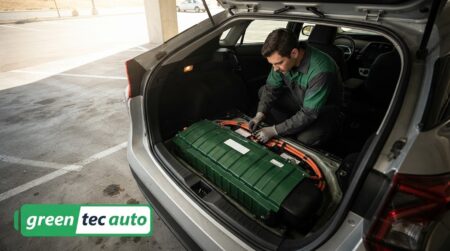
For hybrid and EV owners whose battery concerns persist beyond seasonal range changes, Greentec Auto provides replacement batteries for hybrid and electric vehicles, with more than 30 locations across the U.S., Canada, and the U.K. The company has been replacing hybrid and EV batteries since 2012.
Weather-related range loss on its own does not mean a battery needs replacement, and no reputable shop should tell you otherwise after one cold week. What does warrant a closer look is a measured capacity loss that persists across seasons, a pack that triggers repeated temperature or system warnings, or performance that has dropped and stayed down.
Greentec Auto offers free battery testing and diagnostics so you can find out whether you are looking at a seasonal effect or real capacity loss, and new-cell or remanufactured replacement options with warranty coverage on most qualifying batteries. New-cell packs use new cells rather than reclaimed modules and deliver longer service life than remanufactured options. Modules that fail testing go to Greentec Recycling, where nickel and other metals are recovered from nickel-metal hydride packs and lithium and cobalt are recovered from lithium-ion packs.
Mobile installation is available on many vehicles for an additional cost, and shop installation is required on some models.
Check your year, make, and model on greentecauto.com, or contact Greentec Auto to have your battery tested before you decide anything.
Yes, both do, but differently. Cold temporarily slows the chemistry and increases energy use for heating, which reduces range without damaging anything. Heat reduces range in the short term through cooling demand and, over years of sustained exposure, permanently reduces usable capacity. The practical difference is that cold-weather range loss reverses in spring and heat-related capacity loss does not reverse at all.
Most EVs lose roughly 20% to 30% of their usual range once temperatures drop below freezing, though the real figure varies a lot by vehicle. Cars with heat pumps generally lose less. Short trips lose proportionally more than long ones, because warming a cold cabin and a cold pack is most of the penalty. Preconditioning while plugged in can recover a meaningful share of that loss.
No. Ordinary cold-weather operation does not permanently damage a lithium-ion EV battery, and the range you lose in winter comes back when temperatures rise. Vehicles protect themselves in the cold by limiting charging speed until the pack warms, which is why winter fast charging can feel slow. The one genuine cold-weather consideration is that charging a very cold pack too aggressively is harmful, which is exactly why the car prevents it.
Sustained high temperatures accelerate the internal chemical reactions that reduce a battery’s usable capacity, and that loss is permanent and cumulative. The effect is driven by how hot the pack gets, how long it stays hot, how often it is fast charged in the heat, and how effectively the vehicle’s thermal management system can shed that heat. This is why identical vehicles in Phoenix and Seattle can show noticeably different capacity after several years.
At high temperatures, faster internal chemical reactions contribute to gradual permanent degradation, and the vehicle may throttle charging or performance to protect the pack. At low temperatures, available power and charging acceptance both drop temporarily, and the vehicle spends energy warming the cells. Cells face genuine risk above roughly 104°F to 113°F if cooling is insufficient or failing, which is why persistent temperature warnings deserve attention rather than dismissal.
There is no single rate that applies to every vehicle or climate, because it depends on peak cell temperature, duration of exposure, charging behavior, and the design of the cooling system. A vehicle with passive battery cooling parked outdoors in Phoenix faces far more cumulative stress than an actively cooled vehicle in a garage in the same city. Range loss alone is not a measurement of capacity loss, which is why a diagnostic beats guessing.
Lithium iron phosphate packs generally tolerate heat and frequent full charging better, while nickel-based chemistries generally perform better in cold conditions. Neither is simply superior, and chemistry alone does not predict how a specific vehicle will behave, because pack design, cooling system, and software controls matter just as much. Check which chemistry your vehicle uses before applying any charging advice you read, since guidance written for one can be wrong for the other.
Yes, and it is one of the larger differences between EV models in cold weather. A heat pump moves existing heat rather than generating it, so it delivers more cabin warmth per unit of energy than a resistive heater, and some systems also recover waste heat from the motors and power electronics. If you drive in real winters and do not have a heat pump, using heated seats and a heated steering wheel instead of cabin air is the most effective workaround available.
Occasional fast charging in the heat is not a problem, and on a long trip it is simply the right tool. The concern is repetition: making DC fast charging your everyday routine during a hot summer stacks charging heat on top of ambient heat, and that combination is what drives measurable degradation. When slower charging fits your schedule, especially overnight, use it.
Compare the same route in the same season across different years. Weather effects are seasonal and repeating, so a winter drop that recovers every spring is normal. A reduction that persists after the weather changes, or that gets worse each year, points to real capacity loss. Battery temperature warnings, cooling fans running hard in mild weather, permanently slower charging, or a noticeable loss of power are all reasons to get a capacity measurement rather than keep estimating.
In heat: park covered or shaded, pre-cool the cabin on grid power, charge during cooler hours, and avoid making repeated fast charging your default. In cold: precondition while plugged in, allow extra time for charging, and heat yourself rather than the whole cabin where you can. Follow your vehicle’s own charge-limit guidance rather than a universal rule, because the right target depends on your battery chemistry.
*Offer cannot be combined with other promotions.
We use cookies and similar technologies to operate the website, understand how it is used, and support advertising. Optional analytics and marketing technologies will not be activated unless you give your consent. You can accept all, reject non-essential technologies, or manage your preferences. You can change your choices at any time.
Your browser sends a Global Privacy Control signal, so advertising stays off unless you switch it on yourself.