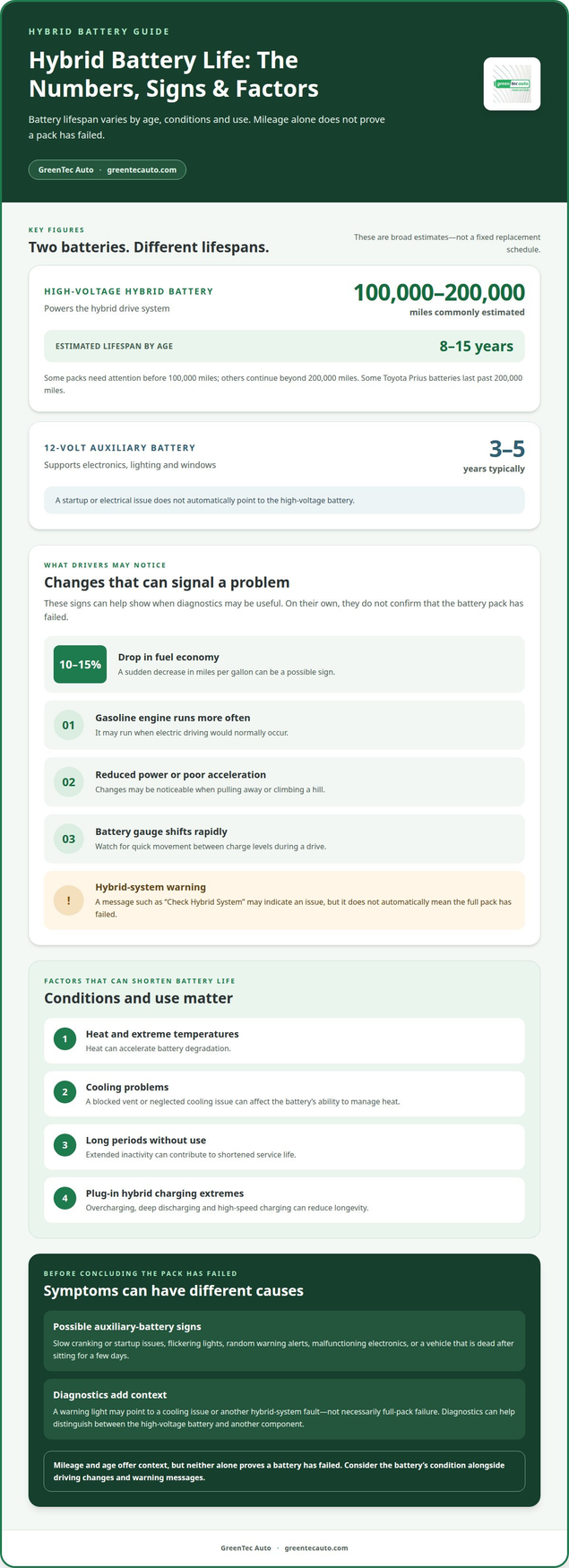
Hybrid battery life expectancy is commonly estimated at 100,000 to 200,000 miles, or roughly 8 to 15 years. Some packs last well beyond that. Others wear out sooner. The range is wide because the number that actually matters is not on your odometer.
It is natural to wonder whether mileage, age, or a warning light means your hybrid battery is nearing the end. Here is the honest answer: a pack’s condition depends far more on heat exposure, cooling, and how the car has been used than on how many miles it has covered. A 200,000 mile Prius that lived in a garage in Oregon with a clean cooling intake can be in better shape than a 90,000 mile hybrid that spent eight summers parked outdoors in Phoenix.
And a warning light does not automatically mean the entire pack needs replacing. It can trace to a cooling fan, a sensor, wiring, or the small auxiliary battery.
This guide covers what actually affects hybrid battery life expectancy, what capacity loss looks like in everyday driving, which habits genuinely help, and when a diagnostic is the right next step rather than a guess.
A hybrid high-voltage battery commonly lasts about 100,000 to 200,000 miles, or 8 to 15 years. There is no single replacement interval that applies to every vehicle.
Those figures describe a broad range, not a deadline. Some packs need attention before 100,000 miles. Plenty of Toyota hybrids run past 200,000 miles on the original battery. Age and odometer readings give you useful context, but neither one on its own proves a battery has failed or that it is fine.
That distinction matters most when you are evaluating a high-mileage used hybrid, or deciding whether your own car’s battery needs attention. Expected life depends on the pack’s measured condition, not the vehicle’s age. Two identical hybrids of the same model year with the same mileage can be in genuinely different shape depending on where they lived and how they were cared for.
Before assuming a hybrid system symptom involves the high-voltage pack, it is worth knowing that your car has a second, much smaller battery. The 12-volt auxiliary battery supports electronics such as lighting, windows, and infotainment, and it typically lasts only 3 to 5 years, far less than the high-voltage pack.
Because of that shorter life, the small battery fails more often, and when it does it can produce symptoms that look alarming: odd warning messages, flickering lights, electronics misbehaving, or a car that is dead after sitting a few days. It is one of the first things any competent diagnostic rules out, and it is a far cheaper answer. Reduced power and poor acceleration point more toward the high-voltage pack; electrical oddities and startup problems often do not.
This is the part most owners never get explained properly, and it is the reason a failing hybrid battery is so easy to misread.
A hybrid battery’s capacity is the amount of energy it can store and deliver. As the pack ages, usable capacity declines, and the vehicle compensates by leaning harder on the gasoline engine.
The decline is gradual. It is not a light switch. That is why a hybrid with a significantly degraded pack usually keeps driving perfectly well, right up until it does not, and why owners are often surprised by a diagnosis that had been developing for two or three years.
In a conventional hybrid, you will see it in fuel economy and engine behavior rather than range. The engine runs more often, it stays on longer, electric-only operation becomes rarer, and your miles per gallon drifts down. There is no range number to watch, because your range comes from the fuel tank.
In a plug-in hybrid, it is far more visible. You get less distance on electric power after a full charge, and because most PHEV owners drive the same commute repeatedly, the change is noticeable on daily trips.
A single unusual drive tells you nothing. Traffic, weather, terrain, cabin heating, and accessory use all move these numbers around, and cold weather in particular can cut a hybrid’s fuel economy by 10% to 25% temporarily without anything being wrong.
What matters is a repeatable change on a familiar route. Compare the same commute, in similar weather, with similar climate control settings, across months or years. Note the route, the conditions, and any dashboard messages. Two readings a year apart on the same drive tell you far more than any single measurement.
And the charge gauge on your dash is not a capacity measurement. It shows the current state of charge within whatever capacity the pack still has. A pack that has lost a third of its capacity can still show a full gauge, because the gauge is showing you “full” relative to a smaller tank. This is precisely why a real diagnostic measures capacity rather than reading the display.
You will see a claim that a hybrid battery is “failing” once capacity falls to about 70% of original. That figure is worth understanding properly, because it gets misused.
Where roughly 70% is meaningful: it is a widely used industry reference point for a pack that is functionally spent, and most manufacturer battery warranties define a covered failure against a stated capacity threshold rather than against any reduction in performance. For electric vehicles and plug-in hybrids from model year 2026 onward, California’s standards formalize a 70% capacity retention requirement across the warranty period, rising to 80% for 2030 and later models.
Where it is not meaningful: that CARB standard applies to EVs and plug-in hybrids, not to conventional hybrids. And no single percentage is a diagnosis. A technician evaluates measured capacity alongside module balance, internal resistance, stored trouble codes, cooling system condition, and how the vehicle actually behaves. A pack at 72% with one badly mismatched module can be in worse practical shape than a pack at 68% that is evenly worn.
The useful takeaway: treat 70% as a rough orientation point, check your own warranty for the threshold it actually specifies, and rely on a measurement rather than a percentage you read somewhere. Warranty coverage and current battery condition answer two different questions.
A high-voltage pack loses performance as its cells age, and several conditions accelerate that. Heat, cooling problems, and long periods without use are the main ones.
This is the part worth internalizing. A warning light tells you the hybrid system has detected a problem. It does not tell you the pack is the problem, and it certainly does not establish that the whole pack needs replacing.
Things that commonly produce hybrid battery symptoms without the battery having failed:
Replacing a pack that was not the fault does not fix the car. That is the whole argument for a diagnostic before a quote.
Because PHEVs charge from an external source, charging patterns matter in a way they do not for conventional hybrids. Habitually charging to 100% and leaving it there, repeatedly running the pack very low, and relying heavily on high-speed charging all add stress over time. Follow your vehicle’s own charging guidance, which usually recommends a middle state of charge for daily use and full charges when you actually need the range. A conventional hybrid has none of these concerns, because it manages its own charge level and you cannot override it.
Sustained high temperatures are the primary cause of permanent hybrid battery degradation. Elevated cell temperatures accelerate the internal chemical reactions that permanently reduce usable capacity, and that loss does not come back when the weather cools.
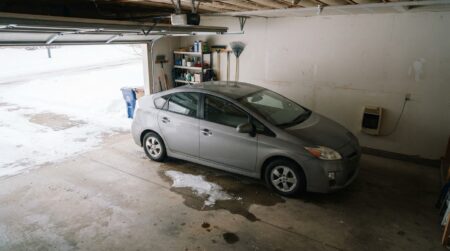
This is why geography predicts battery condition better than mileage does. A pack that spent years parked outdoors in Arizona, Nevada, or Texas accumulated far more thermal stress than an identical pack in Oregon, regardless of what either odometer says. It is also why parking matters: a battery does not have to be in use to be degrading, and a car sitting in direct sun spends hours a day at elevated cell temperature doing nothing at all.
A pack that cannot shed heat properly runs hotter than designed every single time it works. A blocked cooling intake, a clogged filter, or a failing fan turns normal operation into accelerated aging. This is the one heat factor almost entirely within your control, which is what the next section is about.
Leaving a hybrid parked and unused for weeks at a time is harder on the pack than driving it. If you plan to store a hybrid for an extended period, follow the storage guidance in your owner’s manual rather than guessing, and avoid leaving the pack sitting at a very low state of charge.
Short trips never let the system reach its efficient operating temperature, and they are harder on a hybrid than fewer long drives covering the same distance. Combining errands into single trips genuinely helps.
A hybrid system warning left unaddressed can mean a cooling fault quietly cooking the pack for months. The warning itself does not prove the battery failed, but it is a reason to find out what triggered it while the answer is still cheap.
Hybrid battery maintenance comes down to managing heat, sensible storage, and following your vehicle’s service schedule. There is no additive, no reconditioning ritual, and no charging trick that extends the life of a conventional hybrid pack.
Most hybrid high-voltage batteries are air cooled, not liquid cooled. A blower draws cabin air through an intake, pushes it across the modules, and vents it out. On many Toyota and Lexus hybrids the intake sits low near the rear seat or in the trunk area, behind a filter or screen.
Over time that path fills with dust, lint, pet hair, and debris. A restricted intake means the pack runs hotter than designed every time you drive, and heat is what permanently ages it.
What to actually do:
Hybrid cooling designs vary, and this is where a lot of generic advice goes wrong. Many conventional hybrids, including most Toyota and Lexus models, cool the high-voltage battery with air and have no coolant loop serving the pack at all. Those vehicles do have engine and inverter coolant that needs periodic service, but that is a different system from the battery.
Other hybrids and most electric vehicles use liquid cooling for the pack, and on those vehicles coolant condition genuinely affects battery temperature management. Check your owner’s manual for your specific vehicle rather than applying a universal interval, because “replace the battery coolant at 100,000 miles” is simply not a thing on an air-cooled pack.
Park in a garage or covered spot when you can. It will not control every temperature, but it meaningfully reduces the hours your pack spends hot while doing nothing. In hot climates this is one of the few high-value habits actually available to an owner.
Regular use beats long periods sitting. And when a hybrid system warning appears, note when it happened and whether performance changed, then find out what triggered it.
Do not attempt to clean or tighten high-voltage battery terminals yourself. Advice about cleaning battery terminals comes from 12-volt systems. A traction pack operates at hundreds of volts DC, its connections are not owner-serviceable, and opening a high-voltage enclosure without training, insulated tools, and a tested isolation procedure is genuinely dangerous. Leave anything inside the pack to a qualified technician.
Check this before paying for anything, because it occasionally makes the whole question moot.
Typical manufacturer coverage on hybrid high-voltage batteries runs 8 to 10 years and 100,000 to 150,000 miles, depending on the make, the model year, and where the vehicle was originally sold. Years and mileage are separate limits, and coverage ends when either one is reached.
Federal minimums in the United States differ by vehicle type, which is a detail that gets reported incorrectly often:
Vehicle type | Federal minimum battery coverage |
|---|---|
Conventional hybrid | 8 years or 100,000 miles |
Electric vehicle | 8 years or 100,000 miles |
Plug-in hybrid | 8 years or 80,000 miles |
States following California’s emissions standards require longer coverage on certain emissions-related components, and from model year 2026 onward California’s standards add a 70% capacity retention requirement over 10 years or 150,000 miles for EVs and plug-in hybrids.
Manufacturers frequently exceed the minimum. Toyota, for example, extended hybrid battery coverage to 10 years or 150,000 miles starting with model year 2020, up from 8 years or 100,000 miles.
What to actually check:
If you are near the edge of a warranty window and suspect real capacity loss, get it measured now. A measurement taken inside the window is worth considerably more than the same measurement a month after it closes.
Everything above is context. Here is the decision rule.
Get a diagnostic when:
What a real diagnostic tells you that your dashboard cannot: measured remaining capacity, whether modules are balanced or one is dragging the pack down, internal resistance, stored and pending trouble codes, and whether the cooling system is working. That is the difference between “my mileage is down” and “this pack has lost this much capacity and here is why.”
What it saves you: the cost of replacing a pack that was not the fault. Cooling fans, sensors, wiring, and auxiliary batteries all produce hybrid battery symptoms, and all cost dramatically less to fix.
Greentec Auto replaces hybrid and EV batteries at more than 30 locations across the U.S., Canada, and the U.K., and has been doing this work since 2012.
Start with free battery testing and diagnostics. Age and mileage do not establish whether a pack needs replacing, and neither does a warning light on its own. Testing measures what the pack has actually got left and distinguishes real capacity loss from a cooling fan, a sensor, wiring, or the auxiliary battery.
If testing confirms genuine capacity loss, replacement options include new-cell packs built with new cells rather than reclaimed modules, which deliver longer service life than remanufactured options, alongside remanufactured packs where those suit the vehicle and the budget. Warranty coverage applies to most qualifying batteries, and because the network spans more than 30 locations, a claim is not tied to a single address.
Greentec Auto supplies replacement batteries across Toyota, Lexus, Honda, Ford, and other hybrid and EV platforms. Mobile installation is available on many vehicles for an additional cost, and some models require shop installation. Modules that fail testing go to Greentec Recycling, where nickel and other metals are recovered from nickel-metal hydride packs and lithium and cobalt are recovered from lithium-ion packs.
Check your year, make, and model on greentecauto.com, or contact Greentec Auto to have your battery tested.
Hybrid battery life expectancy gives you a useful frame: 100,000 to 200,000 miles, 8 to 15 years, and a decline that is gradual rather than sudden. What it does not give you is an answer about your own car.
The honest version is that your odometer is one of the weaker predictors available. Heat exposure, cooling condition, trip patterns, and climate tell you more. And the only thing that actually tells you where your pack stands is a capacity measurement.
So if you are weighing this up: keep the cooling intake clear, park inside when you can, address warnings rather than waiting them out, and when something changes and stays changed, get it measured instead of estimating from the odometer.
Hybrid battery life expectancy is commonly estimated at 100,000 to 200,000 miles, or roughly 8 to 15 years. That is a broad range rather than a replacement schedule, and the spread exists because condition depends more on heat exposure, cooling system health, and usage patterns than on mileage. Many Toyota hybrids run past 200,000 miles on the original pack, while a vehicle that spent years parked outdoors in extreme heat can need attention sooner.
Heat, by a wide margin. Sustained high cell temperatures accelerate the internal reactions that permanently reduce usable capacity, and that loss does not recover. Cooling problems make it worse, which is why a blocked intake or a failing fan is more damaging than high mileage. Long periods sitting unused, a steady diet of short trips, and ignored warning lights all add stress. For plug-in hybrids, habitual full charges, repeated deep discharges, and heavy fast charging also matter.
In a conventional hybrid you notice it in fuel economy and engine behavior: the engine runs more often and stays on longer, electric-only operation becomes rarer, and miles per gallon drift down. In a plug-in hybrid it is more obvious, showing up as less electric range after a full charge. The decline is gradual rather than sudden, which is why a degraded hybrid usually keeps driving normally while performance quietly slips over several years.
Roughly 70% is a widely used reference point for a pack being functionally spent, and most warranties define a covered failure against a stated capacity threshold. But no single percentage is a diagnosis. California’s 70% retention requirement from model year 2026 applies to electric vehicles and plug-in hybrids, not conventional hybrids. A technician weighs measured capacity alongside module balance, internal resistance, trouble codes, and cooling condition, because a pack at 72% with one badly mismatched module can be in worse shape than one at 68% that is evenly worn.
No, and this is a common misunderstanding. The gauge shows the current state of charge within whatever capacity the pack still has, not the size of that capacity. A battery that has lost a third of its original capacity can still display a full gauge, because it is showing full relative to a smaller usable range. Only a capacity measurement tells you what the pack actually has left, which is why a diagnostic beats watching the display.
It depends entirely on your vehicle. Many conventional hybrids, including most Toyota and Lexus models, cool the high-voltage battery with air drawn from the cabin and have no coolant loop serving the pack at all. Those cars do have engine and inverter coolant requiring periodic service, but that is a separate system. Other hybrids and most electric vehicles use liquid cooling for the pack, where coolant condition does affect battery temperature management. Check your owner’s manual rather than applying a universal interval.
Keep the battery cooling intake clear. On most hybrids the pack is air cooled through an intake behind a filter or screen, and a restricted path means the battery runs hotter than designed every time you drive. Keep the vent unobstructed by bags and belongings, and have the filter or screen serviced periodically, with independent specialists commonly recommending around every 30,000 miles. Parking in a garage when possible is second. Neither takes effort, and heat is what actually ages these packs.
No, and you should not try. Advice about cleaning battery terminals comes from 12-volt systems. A hybrid traction pack operates at hundreds of volts DC, its internal connections are not owner-serviceable, and opening the enclosure without training, insulated tools, and a tested isolation procedure is genuinely dangerous. Anything inside the pack belongs to a qualified technician. What you can safely do yourself is keep the external cooling intake clear.
Typical manufacturer coverage runs 8 to 10 years and 100,000 to 150,000 miles, varying by make, model year, and where the vehicle was sold. Federal minimums in the United States are 8 years or 100,000 miles for conventional hybrids and electric vehicles, and 8 years or 80,000 miles for plug-in hybrids. Years and mileage are separate limits, so coverage ends when either is reached. Many manufacturers exceed the minimum: Toyota moved to 10 years or 150,000 miles starting with model year 2020. Check your own coverage by VIN, including whether it transfers to you as a second owner.
A degrading pack commonly presents as reduced power and weaker acceleration, which can matter in situations that need it, such as merging onto a highway or climbing a grade. Because the change affects how the vehicle performs, get it assessed rather than waiting. If a warning light is on, if you notice a burning or acrid smell, if the pack area is unusually hot, or if you see smoke, stop driving and get professional help rather than continuing to see whether it clears.
Conventional hybrid packs are commonly estimated at 100,000 to 200,000 miles or 8 to 15 years. Plug-in hybrids and EVs use their batteries differently, with deeper charge and discharge cycles and external charging, so they are worth evaluating separately rather than by hybrid figures. Compare expected service life separately from warranty coverage, because the two answer different questions: warranty duration tells you what the manufacturer will cover, not how long the pack will actually last.
Yes, and service life depends heavily on the quality of the work. A pack rebuilt with modules individually tested under load, matched for capacity and internal resistance, with failures rejected and the finished pack balanced, is a legitimate product with a real warranty. A pack of used modules sorted by a quick voltage reading is a different thing sold under similar words, and mismatched internal resistance makes those fail early. New-cell packs avoid the question entirely, because every cell starts at the same point and they deliver longer service life than remanufactured options.
We use cookies and similar technologies to operate the website, understand how it is used, and support advertising. Optional analytics and marketing technologies will not be activated unless you give your consent. You can accept all, reject non-essential technologies, or manage your preferences. You can change your choices at any time.
Your browser sends a Global Privacy Control signal, so advertising stays off unless you switch it on yourself.